
With insights from real experience working with multiple furniture brands
Everything furniture brands need to know about 3D rendering — what it costs, how long it takes, when it makes sense over photography, and how to get the most value from every 3D model you commission. Built from real project data across furniture manufacturers, DTC brands, and retailers in North America, Europe, and Australia.
Rapid Renders/Blog/ 3D Furniture Rendering Guide
Founder · Rapid Renders Studio
May 26, 2026
10 minutes
Real experience
Skip ahead
We’ll send a fixed-fee, line-itemed quote within 2 hours. Or use the live calculator to see a range in 60 seconds.
01 · All about 3D furniture rendering?
3D furniture rendering is the process of creating photorealistic digital images of furniture using computer software instead of a camera. A 3D artist builds a virtual replica of your furniture piece — every curve, stitch, joint, and hardware detail — then applies realistic materials, sets up lighting, and renders a final image that is virtually indistinguishable from a professional photograph.
The furniture does not need to exist physically. It only needs to exist as data — a CAD file, a technical drawing, or even a set of reference photos. From that data, a rendering studio can produce unlimited images: white-background e-commerce shots, styled lifestyle scenes, 360-degree spins, animations, and AR-ready assets — all from a single 3D model.
This is why brands like IKEA, Wayfair, West Elm, and Article have shifted the majority of their product imagery to CGI. The economics, speed, and flexibility simply outperform traditional furniture photography at scale.
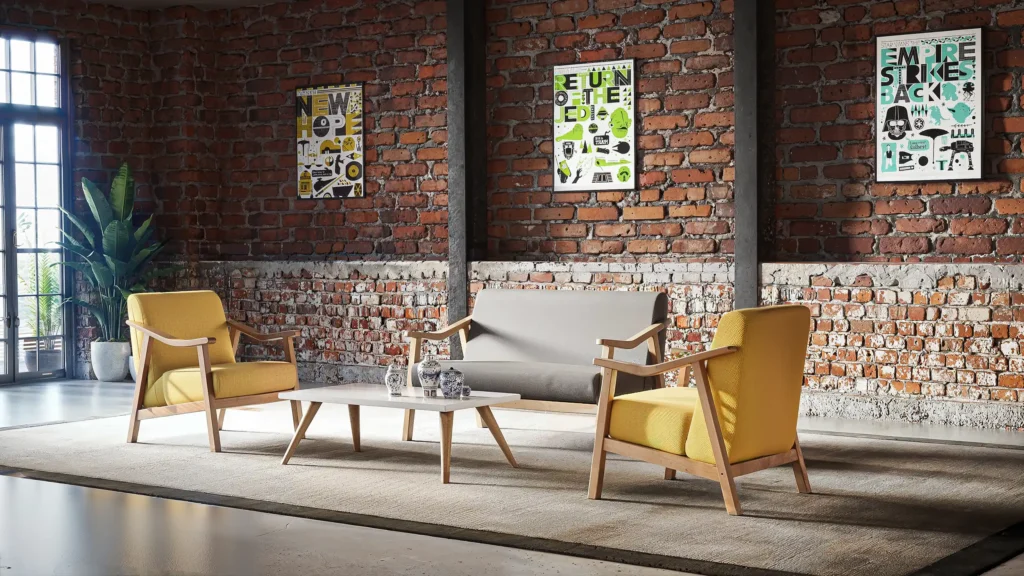
The shift is not about technology for its own sake. It is about solving real business problems that furniture brands face every day:
Product launches are slow. Traditional photography requires finished prototypes, shipping to a studio, scheduling shoots, and waiting for post-production. With 3D furniture rendering, you can have marketing-ready visuals the moment your CAD files are finalised — months before manufacturing is complete.
Photography does not scale. A sofa available in 12 fabrics and 4 leg finishes means 48 variants. Photographing each one requires physically producing and shipping 48 configurations to a studio. With rendering, you create one 3D model and swap materials digitally — 48 variants from a single asset, delivered in days instead of weeks.
Consistency is impossible with photography at scale. Different shoot days, different lighting conditions, different photographers. Rendering produces pixel-perfect consistency across every product in your catalog, from page one to page one thousand.
Returns eat your margins. When customers can see accurate, photorealistic images of exactly what they are buying — including how it looks in a styled room setting — purchase confidence goes up and returns go down. One of our furniture clients saw a 35% reduction in returns after switching from photography to CGI lifestyle images.
Related: 3D rendering vs photography — which is better? See our full comparison →
Not every project needs the same type of visual. Here are the main formats, when to use each, and what they typically cost:
Clean, isolated product images on a plain white or neutral background. These are the workhorses of e-commerce — the images that appear on your product listing pages, Amazon, Wayfair, and wholesale catalogues.
Best for: E-commerce product pages, marketplace listings, wholesale catalogues, specification sheets. Typical cost: $150–$350 per image (after initial 3D model is built). Turnaround: 2–4 business days per product.
Furniture placed in beautifully designed interior environments — a sofa in a sunlit living room, a dining table set for a dinner party, a bed in a serene master bedroom. These are the images that sell the dream, not just the product.
Best for: Website hero images, social media, Pinterest, marketing campaigns, lookbooks. Typical cost: $400–$800 per scene (using existing 3D model). Turnaround: 4–7 business days per scene.
Interactive spins that let customers rotate the product and examine it from every angle. These significantly reduce purchase uncertainty for large, expensive items like sofas, dining tables, and storage units.
Best for: Product detail pages, premium e-commerce experiences, showroom kiosks. Typical cost: $300–$600 per product (36–72 frames rendered from existing model). Turnaround: 3–5 business days.
3D models optimised for AR, allowing customers to place furniture virtually in their own rooms using their phone camera. Apple’s Quick Look and Google’s Scene Viewer have made this accessible without requiring a separate app.
Best for: Mobile shopping experiences, reducing “will it fit?” uncertainty, premium brand differentiation. Typical cost: $200–$500 per product (AR-ready model from existing 3D asset). Turnaround: 3–5 business days.
Short video clips showing furniture from multiple angles, demonstrating functionality (a recliner extending, storage drawers opening), or showcasing a product in a styled environment. These outperform static images on social media and in advertising.
Best for: Social media ads, product launch videos, website hero sections, email marketing. Typical cost: $800–$2,000 per animation (10–30 seconds, from existing model). Turnaround: 5–10 business days.
Understanding the process helps you communicate with studios, set realistic expectations, and avoid common mistakes that slow projects down.
| Step | What happens | Why it matters |
|---|---|---|
| 1. Brief and asset submission | You send CAD files, drawings, photos, dimensions, materials, and mood boards to the rendering studio. | Better input means fewer revisions and a faster project. At minimum, a studio needs accurate dimensions and clear material references. |
| 2. 3D modelling | Artists build a precise digital replica of your furniture in software like 3ds Max, Blender, or Maya — every curve, joint, stitch line, and hardware detail. | The model becomes the foundation for all future images, variants, animations, and AR assets. This is the most time-intensive and most important step. |
| 3. Texturing and materials | Wood grain, fabric weave, leather patina, brushed metal, and other surface finishes are applied using PBR (physically based rendering) materials. | This is what makes the product look photorealistic instead of like a grey clay model. PBR materials define how surfaces reflect, absorb, and scatter light — not just colour, but physical behaviour. |
| 4. Lighting and scene setup | The product is placed in a studio environment (white background) or a styled lifestyle interior with realistic lighting — sunlight through windows, ambient bounce from walls. | Lighting is arguably the single most important factor in whether a render looks convincing. Bad lighting exposes every shortcoming. Good lighting makes even simple geometry look stunning. |
| 5. Rendering | The software calculates how millions of light rays interact with every surface — reflections, shadows, refractions, soft ambient light — to produce the final photorealistic image. | This is the computational step that produces the finished result. A single high-resolution frame can take minutes to several hours depending on scene complexity. |
| 6. Post-production and delivery | Final colour correction, compositing, cleanup, and file formatting for your specific use case. | You receive ready-to-use images in whatever formats you need — high-res for print, web-optimised for e-commerce, transparent PNGs for design teams. |
Theory is useful. Real numbers are better. Here is what a typical furniture collection launch looks like side-by-side.
The brief: A DTC furniture brand launching 8 new products (2 sofas, 2 armchairs, 2 dining tables, 2 side tables). Each piece available in 4 fabric/finish options. They need product images (3 angles per product), 6 lifestyle scenes, and 360-degree views for the hero products.
| Item | Photography cost | 3D rendering cost |
|---|---|---|
| Product preparation / 3D models | 32 physical items to produce and ship | $2,400–$4,800 (8 models) |
| Studio / scene setup | $4,500–$10,000 (3–4 day studio rental) | Included in rendering workflow |
| Photographer / stylist / assistant | $3,000–$6,000 | Not required |
| Shipping and handling | $2,000–$4,000 | Not required |
| Product images (96 shots) | $28,800–$48,000 | $4,800–$8,400 |
| Fabric / finish variants (24 sets) | Requires full reshoots | $1,800–$2,400 |
| Lifestyle scenes (6 scenes) | $4,800–$9,000 | $3,000–$4,800 |
| 360-degree views (4 products) | Difficult for all variants | $1,600–$2,400 |
| Post-production | $3,000–$5,000 | Usually included |
| Estimated total | $46,100–$82,000 | $13,600–$22,800 |
| Timeline | 4–8 weeks | 2–3 weeks |
With 3D rendering, you are not paying to physically produce, ship, style, and reshoot every product variation. Once the 3D models and lifestyle scenes are created, they become reusable digital assets — available for new angles, fabric options, finish variations, 360-degree views, animations, AR assets, and future marketing campaigns at a fraction of the original cost.
In this example, 3D rendering reduces the total launch cost by 60–72% while cutting the timeline in half.
We'll send a fixed-fee, line-itemised quote within 2 hours.
Or use the live calculator to see a range in 60 seconds.

This is what most 3D furniture visualization studios do not openly explain: you do not need a unique lifestyle scene for every product.
Lifestyle renders — furniture placed in beautifully designed room environments — are the highest-impact visuals for driving sales. Customers emotionally connect with a product when they can see it in a real space. But when brands have large catalogs with hundreds of products, creating a unique room for every item becomes prohibitively expensive at $400–$800 per scene.
The smarter approach is to build a small library of premium reusable scenes.
A single well-designed living room environment can support dozens of different products by swapping the furniture model placed inside it. The same room scene works for sofas, armchairs, coffee tables, side tables, accent chairs, lighting, and decor accessories — without rebuilding the environment, lighting, or camera setup each time.
If you commission 4 premium room scenes (living room, bedroom, dining room, home office) at $600–$800 each, that is a one-time investment of $2,400–$3,200. Now every product in your catalog can be placed into any of those 4 rooms for just $100–$200 per swap — the cost of inserting the 3D model and adjusting minor details.
The maths: 30 products × 4 lifestyle scenes each = 120 images. Built from scratch: 120 × $600 = $72,000. Reusable scene approach: 4 scenes × $700 + 120 swaps × $150 = $20,800. That is a 71% cost reduction with identical visual quality.
Many brands assume every marketing image requires a completely new scene. In reality, a professional 3D artist can generate 4–6 distinct marketing images from one environment simply by adjusting the camera angle, focal length, and crop. A wide room shot, a close-up product detail, an overhead angle, and a zoomed lifestyle vignette — all from the same scene file.
One scene at $600 producing 5 usable images brings your effective cost per image down to $120.
Instead of rebuilding or remodelling products for each variant, materials and finishes can be swapped digitally within minutes. Wood textures, upholstery fabrics, metal finishes, and paint colours can all be changed while the environment, lighting, and composition stay identical. A sofa available in 8 fabrics does not need 8 separate lifestyle shoots — it needs 1 scene and 7 material swaps at $50–$100 each.
The biggest expense in furniture lifestyle rendering is not the final render. It is the scene creation — the environment modelling, interior styling, lighting setup, and camera composition. Once those are built properly, scaling production becomes dramatically faster and more affordable.
This is exactly how large furniture brands like IKEA and Wayfair operate: they build reusable rendering pipelines rather than treating every image as a separate project. The result is visual consistency across the entire catalog while keeping production costs under control.
Rendering is not always the right answer. Photography or other approaches may be better when:
some design publications and journalists specifically request real photographs. Check the requirements before investing.
For a very small scope with the finished product on hand, a local photographer may be faster and comparable in cost.
The visible imperfections, tool marks, and natural variation of truly artisanal furniture are difficult and expensive to replicate digitally. If those imperfections are what make your product special, a photographer captures them more efficiently.
Natural rattan, hand-woven cane, live-edge timber with unique grain patterns. These can be rendered beautifully, but matching the specific randomness of a one-of-a-kind piece takes more artist time than photographing it.
For everything else — manufactured furniture with defined specs, multiple SKUs, fabric/finish variants, e-commerce catalogs, and any situation where you need visuals at scale — 3D rendering is the more efficient and cost-effective approach.
Related: Still deciding between rendering and photography? Read our detailed comparison →

Most guides tell you to check the portfolio, ask about turnaround, and compare prices. That advice is fine for one-off projects. But when your brand is producing hundreds or thousands of catalog images every year, the decision comes down to two things: image quality and production cost per image.
At scale, rendering is a production system, not just a creative service.
A studio might have a beautiful portfolio, but if each image costs too much, maintaining profitability across a large catalog becomes difficult. On the other hand, choosing the cheapest option often leads to inconsistent quality, poor communication, delays, and revision costs that erase the savings.
The goal is to find a studio that delivers strong visual quality at a sustainable production cost.
One of the biggest factors affecting rendering pricing is where the studio is based — and it is rarely discussed openly.
Studios in the US, UK, Canada, or Australia typically charge significantly more because of higher salaries, office rent, and operating costs. Meanwhile, studios in regions like Sri Lanka, India, Vietnam, and the Philippines can often deliver very similar visual quality at 30–50% lower cost.
This is possible because the software is the same (3ds Max, V-Ray, Blender), the rendering pipeline is the same, the hardware is comparable, and many artists are trained to international standards. The difference is operating cost, not capability.
For large furniture catalogs, this gap becomes enormous. A brand producing 1,000 product images could spend $300,000–$800,000+ with Western studios — or significantly less with an experienced offshore team delivering the same quality.
The best rendering is not always the most expensive one. If a render looks realistic, represents the furniture accurately, matches the brand style, and helps customers buy confidently — it already serves its purpose.
In most cases, customers cannot tell whether an image was created by a studio in London, New York, Colombo, or Bangalore. What they notice is whether the product looks real, the fabrics look accurate, and the lifestyle scene feels aspirational. Those outcomes are about studio skill and process, not studio postcode.
| Factor | What to look for | Why it matters |
|---|---|---|
| Portfolio specificity | Examples of furniture rendering specifically — not just architectural interiors or generic CGI. Look for fabric behaviour, wood grain realism, upholstery detail, and catalog consistency. | Furniture rendering is a specialised discipline. A studio that excels at building exteriors may struggle with the close-up material accuracy furniture demands. |
| Material accuracy | Zoom into their portfolio. Do fabrics show realistic weave? Does wood grain follow the geometry? Do metals reflect correctly? Do cushions look soft? | This is the single clearest indicator of studio capability. Poor materials make products look fake instantly — and drive returns. |
| Communication process | Ask how they handle feedback. Do they have structured revision rounds? How fast do they respond? Do they ask the right questions upfront? | For large catalogs, communication efficiency saves more money than the per-image price. A studio that needs 5 revision rounds costs more than one that needs 2 — even if their base price is higher. |
| Pricing transparency | Request an itemised quote: cost per model, per render, per variant, per lifestyle scene, per animation. No vague “project-based” pricing. | Predictable costs are essential for catalog budgeting. If a studio cannot give you clear numbers before starting, that is a red flag. |
| Turnaround reliability | Ask for references from catalog-scale clients. Do they deliver on time? Can they scale when you need 50 images in a week? | Missed deadlines for product launch visuals cost far more than the rendering itself. Production reliability at scale is non-negotiable. |
| File ownership | Clarify who owns the 3D models after the project. Are source files included? Can you reuse assets for future campaigns, AR, or animation? | Some studios retain ownership and charge licensing fees for reuse. Others (including us) transfer full ownership upon payment — the models are yours forever. For long-term catalogs, this matters enormously. |
| Scalable production | Can the studio handle 20 images this month and 200 next month? Do they have a team, or is it one freelancer? | Furniture catalogs are seasonal. You need a studio that can scale up for launches and scale down between them — without sacrificing quality or turnaround. |
Send us one product photo or CAD file. We'll create a complimentary test render so you can judge the quality before committing to a full project.
Case study:
Tandem Arbor is an American-made custom furniture brand known for high-quality, made-to-order pieces with extensive fabric and configuration options. The challenge: photographing every combination was logistically impossible and financially unsustainable.
The problem: Dozens of product configurations, each available in multiple fabrics. Traditional photography could only capture a fraction of the available options, leaving most products without visuals for their full range.
The solution: We built detailed 3D models of their core product line and rendered every fabric and configuration variant digitally. One 3D model, unlimited variants — each one photorealistic and consistent with the rest of the catalog.
The result: Tandem Arbor now launches new fabric options with photorealistic visuals within days, not weeks. Their entire online catalog has consistent, professional imagery across every variant — something that was impossible with photography.
At this point, you know the prices and where the hidden costs lurk. Here’s how to optimize your spending – not by going cheap, but by being strategic.
Our live calculator gives you a real range in 30 seconds. A line-itemed quote follows in 2 hours.
The most asked
3D furniture rendering typically costs $150–$350 per studio image and $400–$800 per lifestyle scene, after the initial 3D model is built. The model itself costs $200–$1,000 depending on complexity — a simple side table is at the low end, a detailed tufted sofa with multiple cushion configurations is at the high end. Colour and material variants from an existing model cost $25–$100 each. For a typical collection launch of 8 products, brands spend $13,000–$23,000 for a complete visual package including product shots, lifestyle scenes, and 360-degree views..
Standard turnaround is 3–7 business days for product renders and 5–10 business days for lifestyle scenes, after the 3D model is approved. Initial model creation takes 3–5 business days depending on complexity. Rush delivery in 24–48 hours is available for urgent projects. A full collection launch (8–12 products with variants) typically takes 2–3 weeks from brief to final delivery.
With a professional rendering studio, no. Modern rendering engines simulate physically accurate light behaviour — how light bounces between surfaces, scatters through translucent materials, and creates soft shadows — with such precision that even industry professionals frequently cannot distinguish renders from photographs. IKEA has used CGI for the majority of its catalog imagery for years, and most consumers have no idea.
The ideal starting point is CAD files (STEP, IGES, SKP, DWG, or native SolidWorks/Rhino/SketchUp files) with accurate dimensions, plus reference photos or physical samples of materials. If you do not have CAD files, detailed technical drawings with measurements from three views (front, side, top) plus reference photos work well. At minimum, studios can work from clear product photographs with a visible measurement reference.
For most furniture brands selling online, yes. 3D rendering is faster (days vs weeks), cheaper at scale (especially for fabric and finish variants), and produces perfectly consistent imagery across your entire catalog. It also enables 360-degree views, AR experiences, and animations from the same 3D model — capabilities that are impossible or prohibitively expensive with photography.
This varies by studio. Some retain ownership and charge licensing fees for reuse. At Rapid Renders, we transfer full ownership to you upon final payment. The 3D models are your exclusive property — you can reuse them for future renders, animations, AR, configurators, or any other purpose without additional licensing costs..
Yes. A single high-quality 3D furniture model can be repurposed for product images, lifestyle scenes, 360-degree views, augmented reality experiences, product animations, interactive configurators, and virtual staging — all without rebuilding the model. This is one of the biggest advantages of investing in 3D rendering: the asset pays for itself many times over..
At Rapid Renders, we specialise in photorealistic furniture visualisation for brands, manufacturers, and retailers across the US, UK, Canada, and Australia. From product renders to lifestyle scenes, 360-degree views, and animations — we help furniture brands sell more with better visuals at a fraction of the photography cost.
Our clients include Tandem Arbor, Tabilo, and ØRN Furniture, among others. We deliver in days, not weeks, with transparent pricing and unlimited revision rounds.
Get your free test render → | See our furniture portfolio → | Check pricing →
Founder · Rapid Renders Studio. Sixteen years in 3D visualisation. Writes about pricing, production and the practicalities of commissioning renders that actually convert.
About the studio
We ship photoreal stills, cinematic animations and interactive tours for developers, architects and brands. Fixed-fee, founder-led, 1,000+ renders delivered since 2019..
Ready when you are
Your Calculator Selection is attached Automatically.